The Single Question No Automotive Software Can Answer
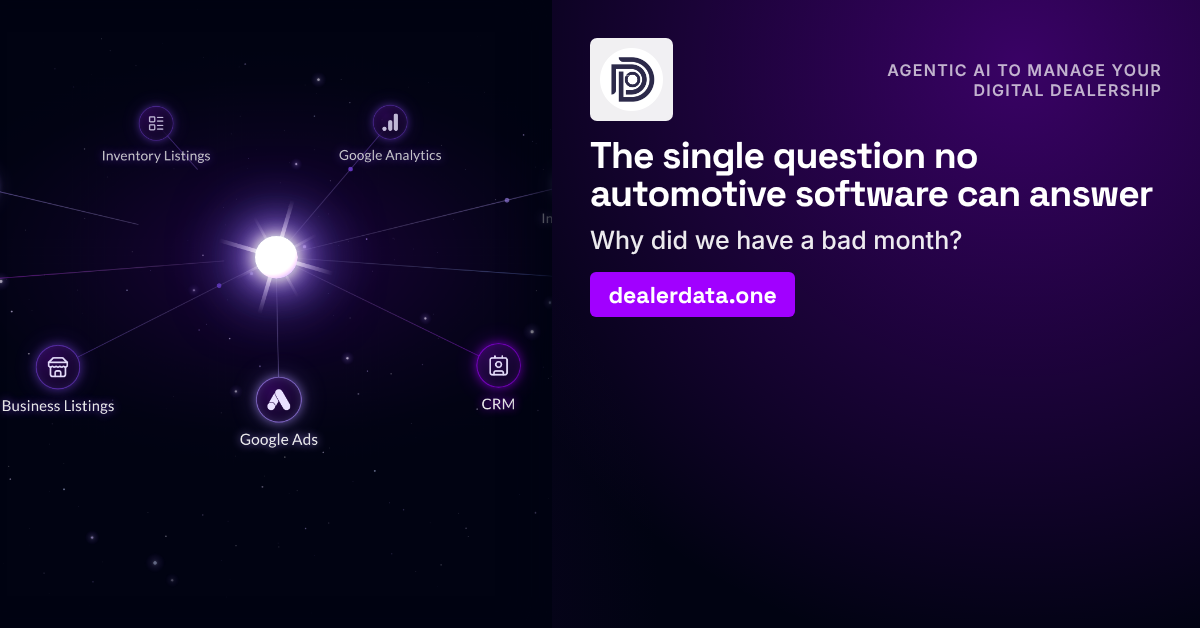
What is the one question no current dealership software can answer?
"Why did we have a bad month?"
It sounds simple. It isn't. And the fact that no automotive software — not CDK, not VistaDash, not Fullpath, not any of the AI tools launched in the last two years — can answer it directly and completely is the clearest definition of the market gap that this series has been building toward.
Why is that question so hard to answer?
Because answering it fully requires holding six categories of data simultaneously, understanding how they interact, and distinguishing between causation and coincidence. You need to know whether organic traffic was down and why. Whether paid search impression share dropped. Whether a website performance issue raised bounce rates. Whether lead volume fell or lead quality fell — and which sources underperformed. Whether inventory had gaps in the segments customers were actively searching for. Whether the dealership's reputation signals changed. Whether a competitor ran an unusually aggressive promotion in the same market during the same period.
The story lives in the connections between those data points — not in any single one of them. No platform today holds all of them. And none of them were designed to surface the connections automatically.
How does a GM answer that question today?
Manually. Usually an experienced GM, a dealer principal who pattern-matches from years in the business, or a consultant who gets paid to do exactly this kind of synthesis. They log into each system one at a time, pull reports, build a spreadsheet, form a hypothesis, try to validate it against data from a different system, and often end up with two or three plausible theories and a judgment call about which is most likely true.
That process takes hours, sometimes days. The conclusion is usually directionally correct but rarely precise. And because it's manual, it doesn't happen continuously — it happens at the monthly review, which means the problem being diagnosed is already a month old by the time anyone understands what caused it.
What are the AI tools actually doing — and what can't they do?
The AI chat widgets — Impel, DealerCX, and their peers — are customer-facing. They respond to inbound inquiries. They have no capability to analyze business performance and are not designed to.
The AI Co-Pilots being rolled out by analytics platforms like VistaDash are interface improvements on top of existing dashboards. They let you ask questions about the data already in the platform — but that platform only holds marketing data. Ask it why you had a bad month and it gives you an answer bounded by impressions, clicks, and leads. It cannot factor in inventory, reputation, or competitive context because it doesn't have that data.
The AI features being embedded in DMS platforms like Tekion can analyze transaction and operational data — but only within their system. They can tell you your gross per copy and service absorption. They cannot tell you why leads were down.
Every tool answers a version of the question, bounded by what it can see. None can answer the whole thing because none hold the whole picture.
Is this a feature gap or something more fundamental?
It's structural. It's rooted in the fragmentation of data across systems that were never designed to work together — maintained by incumbent vendors whose revenue model depends on that fragmentation, and reinforced by startup dynamics that push new entrants toward narrow point solutions.
Closing the gap requires starting from the data layer: building the aggregation infrastructure first, across all the source systems a dealership actually runs, before building the intelligence layer on top. That's the part that can't be shortcut. It's also the part that makes the solution defensible once it exists.
What should the answer to that question actually look like?
One login. All the data. Plain language. A diagnosis, not a dashboard. Actionable next steps. Available in real time — not at the end of the month after a manual reconciliation. That's what closing this gap looks like. And that's the problem Dealer Data One was built to solve.